
First: There is a TON of stuff that I cannot begin to put in a blog so I will put a link to the Ehlers Danlos Website here because you could fall down a well of information for hours. And depending on your level of education and intelligence, actually understand some more advanced nuances like inheritance patterns and chromosomal markers.
Second: I definitely have been diagnosed with Hypermobile Ehlers-Danlos Syndrome. Also previously known as Ehlers-Danlos Syndrome Type 3 (or III), or abbreviated as hEDS (small ‘h’). There is a bit of confusion as there is also something called Hypermobile Spectrum Disorders (HSD) and some doctors treat hEDS as HDS. Same diagnosis, two words. Other doctors don’t feel that’s quite correct, sort of like perhaps one is more severe than the other. It’s a bit of a dealer’s choice thing. Since there isn’t a specific blood test for hEDS (More on that later) they can’t point to something and say “there, she has hEDS, not HSD.”
Third: There is a possibility I may have “Classic EDS” in addition to hEDS. This one can be genetically tested for, however, if you live in America, you know insurance is unlikely to test you for something you don’t absolutely need, and even if they do agree, you still have to pay a pretty decent bit yourself in co-pay. I have my diagnosis for hEDS. Classic EDS won’t get me anything further *at this time.*
Now, numbers. If you want ALL the numbers for all 13 flavors of EDS, go to the site.
Hypermobile EDS is thought to be affecting 1 in 3,100 – 5,000 people but it is very likely underdiagnosed as it is so understudied. Symptoms include joint hypermobility, joint instability, chronic pain, mild skin hyperextensibility, abnormal scarring, chronic fatigue, incontinence, TMJ, osteoarthris, muscle spasms, heart issues (more on this), GI issues, dysautonomia, headaches, & mast cell activation diseases. Mind you, people don’t often have all of them, or at the same time. It’s often a spectrum, but there is a checklist with requirements of like “you must meet 5/9, and at least this many from part A, and this many from part B…” you know the sort.
I, myself, had to educate my own doctor and go on an adventure through a few doctors just to get a diagnosis. Luckily, I have an awesome GP who was happy enough to help me get referred to a rheumatologist. While I was not able to continue to see the rheumatologist as I had no issues requiring immunology support, he was familiar with going through the screening checklist (here). I scored 8/9 on the Beighton Checklist. The only thing I *couldn’t* do was palm the floor with my knees straight while standing. FFS people, I cannot even *TOUCH* the floor with the tips of my fingers. I stand there and swing my hands back and forth like some sort of demented pendulum blade. My knees bend backwards more than 10 degrees – remember “locking” your knees to stand straight? Yeah, that’s a lot of stress when your knees go backwards. My knees also are prone to subluxations and dislocations. My ankles tend to hit the floor if I do not wear orthotics as they have instability. I look like I have flat feet, but I really have decent arches, but my ankles would roll so hard they’d practically be on the ground (sometimes actually touching).
My hips are becoming weak now. My back as well. My back has been a problem for many years, actually. I have have my tailbone broken three times since I was in high school. This has caused my lower back to be a real pain in the ass, literally. The past three years or so, my hips have begun becoming painful. I have begun using a cane when going places where I am unsure of myself, the ground, or how long I will be walking. At 45, it seems so… sad. I have also noticed there is a band across my back, right about where my bra band lays that tightens up and makes it troublesome to breathe due to pain when I am walking too much.
I recently had to go to the clinic as my back and spine spasmed so bad it didn’t get better for a week, and I finally gave up and had to go in for some meds. I couldn’t walk. I couldn’t sleep. Absolute agony. And it just happens. No injury involved. I actually just bent over at a 45 degree angle to reach for some tampons on a shelf and my back seized. I had to call my husband on the phone – not text – which is basically DEFCON 1. I never call.
There are some Fun Party Tricks that I never even noticed until it came time for my diagnosis. I have the Steinberg sign, (put your thumb under your 4 fingers and close them- can you see the full top joint of your thumb outside your fist past your pinky? You can crunch your fingers if you want. If you can do it, it’s positive. If you can’t do it, it’s negative) and the Walker-Murdoch Sign (wrap your hand around your wrist and see if you can get your pinky and thumb to overlap).
I have what the call “EDS Face.” No, really. I have no idea who comes up with these names, as they are not exactly winning any prizes for being delicate. Essentially, what it means is my face is assymetrical in a vertical way. One eye is lower, thin upper lip, thin nose, bruising under eyes, bulging bags under the eyes, thin skin, pointed chin, and small (or no) earlobes. Like the attached kind.
Fun Fact: Your heart is made of cartilage. This means EDS has a direct effect on things like valves, aorta, and can cause POTS. I learned I needed to get a cardiologist added to my slew of doctors when I was there for my husbands transesophogeal echocardiogram and his doctor noticed my cane. When he asked about my knee, I mentioned hEDS he said I needed a cardiologist, which naturally confused me, as knees generally don’t require cardiology. Then he explained that the cartilage that is breaking down everywhere else is also in my heart… possibly breaking down. So, you know… best to have that on a yearly upkeep schedule. I flat out stole my husband’s cardiologist. He knew what hEDS was, was obviously in our insurance network, and cared enough to point out the connection between hEDS and cardiology. Trifecta.
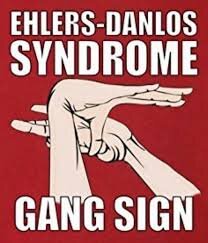
Oh, and we have our own Gang Sign, guys. Take your thumb, and make it touch the forearm of the same arm. EDS Homies.
Oh, and there’s something called hypermobile skin. Goes a long way to explaining why people thought I was randomly mauled by a tiger as a teen. Atrophic scars. The stretching of the skin when teens hit puberty and have growth spurts leave harsh wide reddish purple lines. Mine were horrible. And I thought everyone had them, so I was so embarrassed when someone pointed them out and asked me “oh my god, what HAPPENED?!” Then I realized, they thought someone *DID* that *TO* me. Later, pregnancy did the same to my stomach, but I expected that. Classic EDS is more known to have the atrophic scarring though. This is part of the reason I think I may have that subtype as well.
Classic EDS – affects 1 in 20,000 – 40,000 people. Symptoms are skin hyperextensibility (stretchy skin), atrophic scars, easy bruising, joint hypermobility, joint instability, flat feet, chronic pain, hernia, prolapse. This is caused by autosomal dominant pattern. For those playing the Home Game, if your parent has it, you have 50% chance of having it. But about half the people that get the Classic version have a “de novo” variant (a random mutation).
My dad likely had some form of EDS. I only knew him as a very heavy man, so everyone assumed his knee issues were due to the fact he was carrying around enough poundage for at least two rugby players. My earliest photos with him had him at about 300 lbs. When he died he was around 600, possibly less after surgery, and a month in the hospital, but the point stands. All growing up I watched him move from one cane to two to arm crutches then to an electric wheelchair. Eventually he got a van where he could move from his wheelchair to the chair in the van and drive around, with an electric lift. We chalked the super stretch marks to his massive girth. I mean, it’s a fair thought, right? A man triple the size of a standard human might have some stretch marks from eating as much as he did for as long as he did. He also had issues with hernias. He was born with one, as is not *totally* unheard of with little boys. Later when I was in high school he had surgery to have mesh installed to keep his guts from bulging out of place. It was the mesh that later was recalled. But at his weight they didn’t want to do surgery to replace it as they thought he’d die on the table. He had become obese to the point that his muscles could not keep everything where it needed to be. Especially his GI tract. About that… guess what is another symptom of EDS? GI issues. Hernias. Pronation. Chronic pain. Abnormal scarring. Flat Feet. He probably had Classic Flavor. Also, I recently discovered my cousin has issues with it, though not diagnosed, and her children all have issues as well. That’s four more people. So that is a genetic component. And my son definitely has it – though at this point, I would say he has hEDS.
There are so many things that change when you finally look through the lens of something that connect your symptoms rather than finding 12 unlinked diseases. The only issue is that more doctors don’t study this disorder. It’s like seeing the ancestors above 6 generations of family members. So much is connected.
Stay Stripey Guys!
Leave a Reply
You must be logged in to post a comment.